

A Body Surrendered.
by Mihika Malhotra · · 5 min read
In the discussions that follow, three artists represented by SAC Art Amsterdam at NAP+ meet at the crossroads of memory, nostalgia and belonging, each finding a different route toward home.
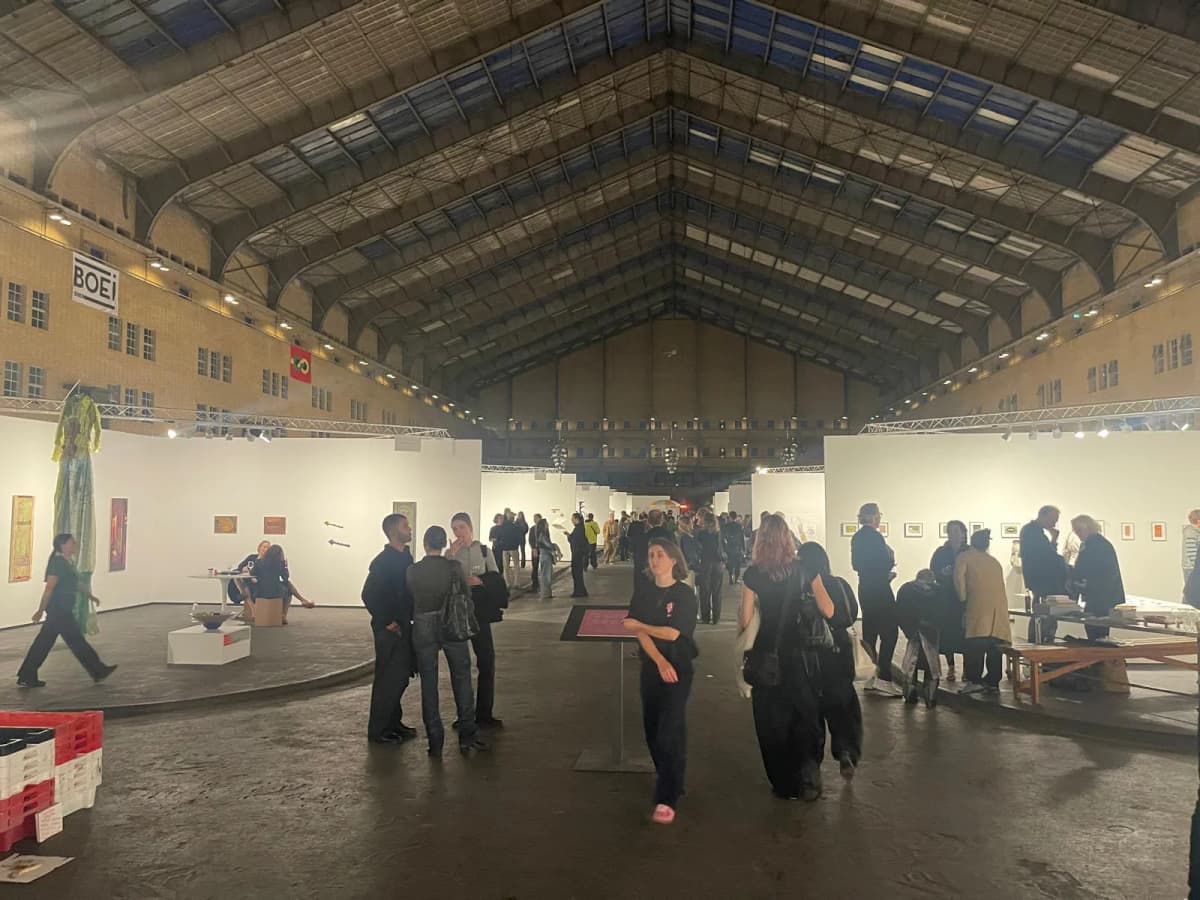
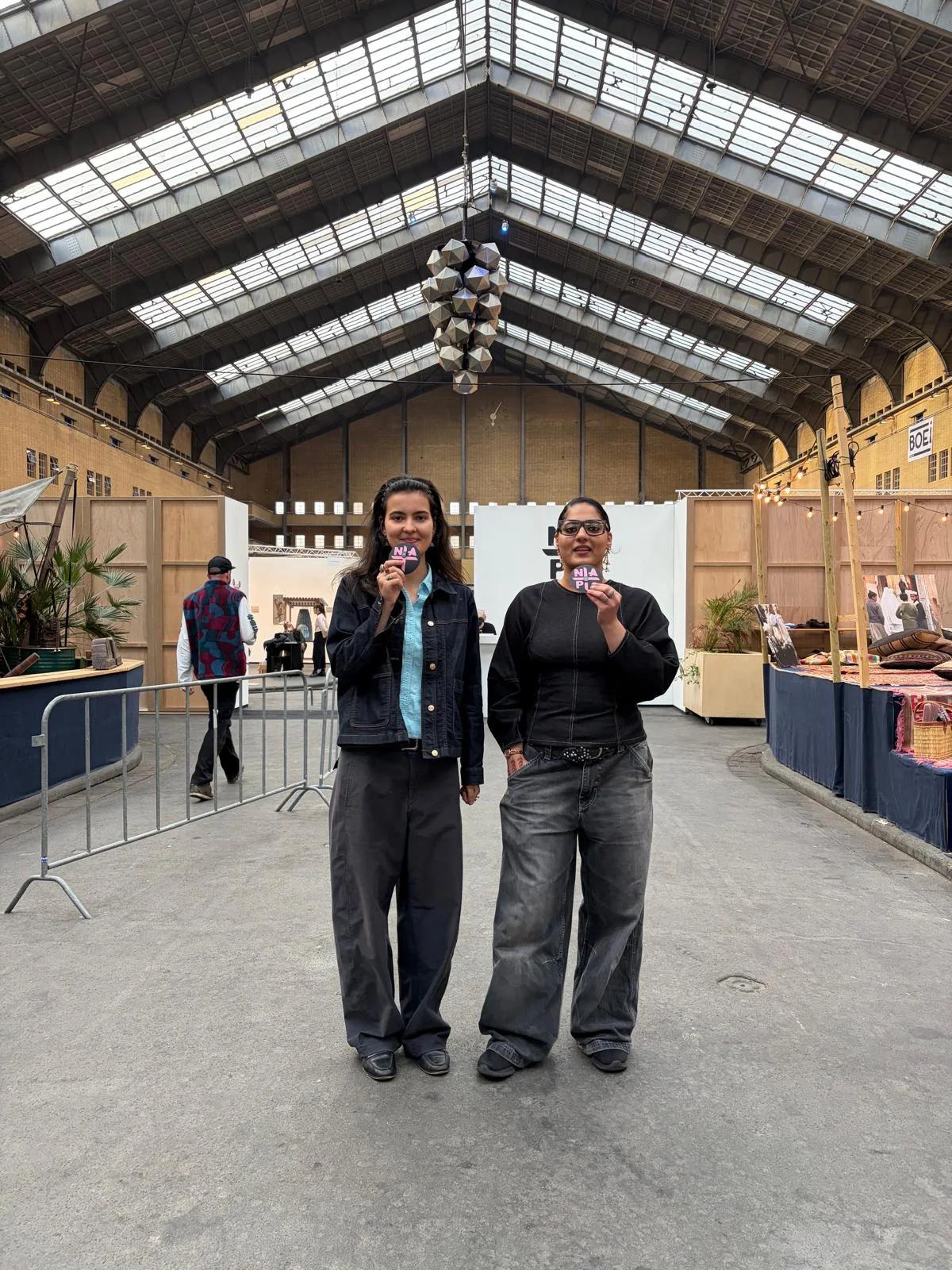
We first arrived at NAP+ on a Thursday evening, the first day of the event. With the storm clouds on our tails, we walked what could only be described as the red carpet. This fake red grassy terrain started at the entrance of the Central Markthal’s scaffolding entrance, and ended at the door of the wholesale food market building. Our shoes were soaked through, our clothes were practically a different colour, and with a trail of damp footsteps suddenly upon the Markthal’s cement floor, we began the walk through the NAP+ exhibition. A grand open space that resembles something of an airplane hangar, the Markthal is known, historically, for being the site of the open and food markets that used to be and continue to be a vibrant part of the city’s culture.
Each gallery that had been selected for this year’s exhibition was given its own booth, some bigger and some smaller, erected from white plaster atop the Markthal’s ground. Music echoed throughout the building, and echo box panels were organised throughout the day; artists from several backgrounds and disciplines gathered in the echo box’s living room-esque set up as they were continuously encouraged to engage in various and transparent conversations with one another, two of our own interviewees engaged in these panel discussions, talking about all things inspiration to the capitalist doom wheel that sometimes claws at their art.
NAP+ is a yearly art fair, taking place in Amsterdam’s Central Markthal, founded by gallerists Sara Lang and David Van Doesburg in 2024. Its aim is to be an art fair and convention for both those looking to purchase contemporary art/pieces, and for those looking to simply look around and explore the different contemporary artists whose work resides within the city.
Among the booths at NAP+, South Asian Contemporary (SAC) Art Amsterdam makes a double debut, appearing at its first fair and becoming the first gallery devoted to South Asian contemporary art to show at a Dutch fair. Behind it is Tasneem Hatimbhai, who founded the gallery in 2024. Born in Bombay, India and a longtime Amsterdam resident, Tasneem came to the art world through words rather than walls. She spent years writing and interviewing artists, gallerists and academics across India’s modern and contemporary scene. Her work kept returning to the intersection of art, architecture and cultural history.
Opening a gallery came as the natural next step. Her aim was a “platform to be a sustainable, consistent hub for all things creative in South Asian contemporary.” Belonging runs through her thinking. For Tasneem, it means standing apart while still feeling seen and valued. Shaped by constant shifts, both geographical and personal, she sees belonging as less about geography and more about purpose, and that purpose is what fuels the establishment of her gallery.
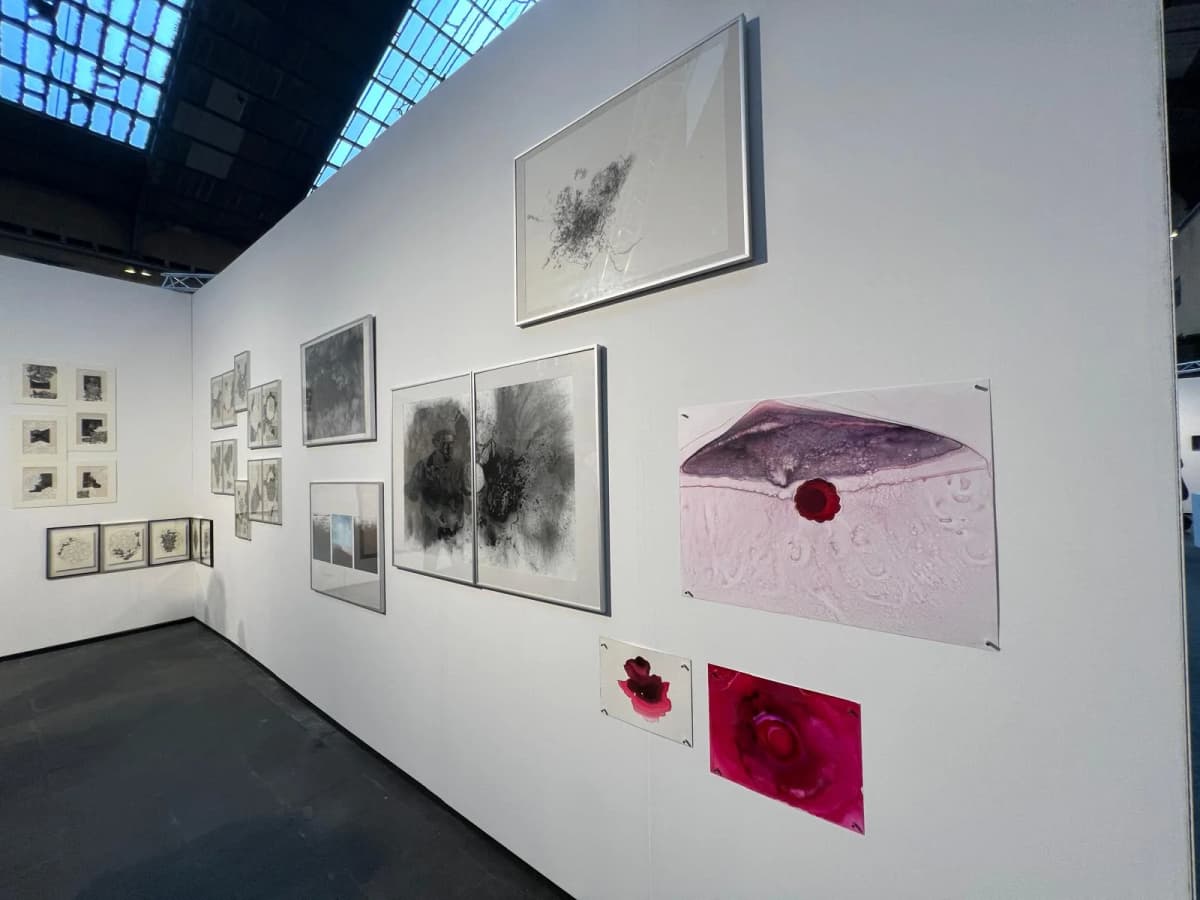
The gallery’s focus is not a narrow one. “The biggest theme is contemporary art,” she says. The gallery is niche in its specialisation but wide in its reach, spanning work from India, Pakistan, Bangladesh, Sri Lanka, Bhutan and Afghanistan, as well as the diaspora. “South Asia cannot be contained to one geographic region anymore,” she continues, “so best to explore the whole gamut of it.”
With a first fair and a first-of-its-kind position, the question was which artists could represent the gallery together. Tasneem and her team spent a year on the process, working through “different permutations and combinations” of artists and works before settling on three.
She studies the portfolio, where they have shown and where they hope to show. Formal education can matter, but sometimes it is not the most relevant. Mostly it comes down to the art and the practice: “We show artists who have been doing this and will do this for the rest of their life.” That is where the passion draws from. It is a vow as much as it is a selection process, a bond with those for whom creating is not a choice but a way of being.
The three she chose span generations. Aditi Singh has a practice of more than 30 years, Samanta Mehta Batra of 20, and Vihaan Singh is just 19. Their mediums and styles differ, but all three, in Tasneem’s words, “intrinsically hold and inspire conversations about home and identity.” Placed side by side, the artworks echo remnants of soul, memory and nostalgia.
Sitting down with Aditi Singh at NAP+ began with a conversation about what it means to let go of control, and what it means to curate an environment within which time and space can be felt intimately and closely, and, here, she begins with the breath. “Yoga teaches you very quickly,” she says, “that control is actually about the breath, and if you’re not breathing in a certain way you’re going to fall apart either way.” Aditi’s creative practice feels as though it is located within the body, cushioned somewhere between slowing down and actually stopping. Her work is lined with intention and discipline, engraved with a structure dictated by following the various habits of nature. Slowing down means doing so “with intention,” and the same discipline, she explains, is what makes her paintings possible.
Aditi is an artist from Bombay who works primarily with ink on paper, and most of her work, she says, “is a response to being in nature and being in yoga.” The paper she favours is Japanese washi, which is highly absorbent and forgives nothing. If her intention is “wobbly,” the ink “can be a hot mess, it can just go all over.” Her relationship with the paper, and with the craft itself, does not imply that mistakes or imprecision should force one to grip harder. Aditi explains that if she does not know what the work will become, but accepts that she is “in the process of becoming,” she says, “then it all kind of falls into place.”
That is a particular idea of stillness; one that predates the artistic process itself and acts not as an absence of action but a kind of attention so complete that the artist stops predicting.
Aditi works in single colours and builds up their density, thus, eventually the colour takes over. “The intensity of the colour dictates where the painting is going to go and my hand has just to follow it. I can’t force it to go in a different direction.” The question of authorship, whether the work belongs to the artist or the material, gets the answer “somewhere in between.” Knowing when to intervene, she says, is a matter of sensitivity and of knowing your medium. Form and meaning cannot be pulled apart: “the content is the concept and vice versa.” Aditi Singh therefore forms this bilateral relationship to her work, focusing on feeding it from within but also conceiving of her creative process as something that too shapes her, in this process of becoming.
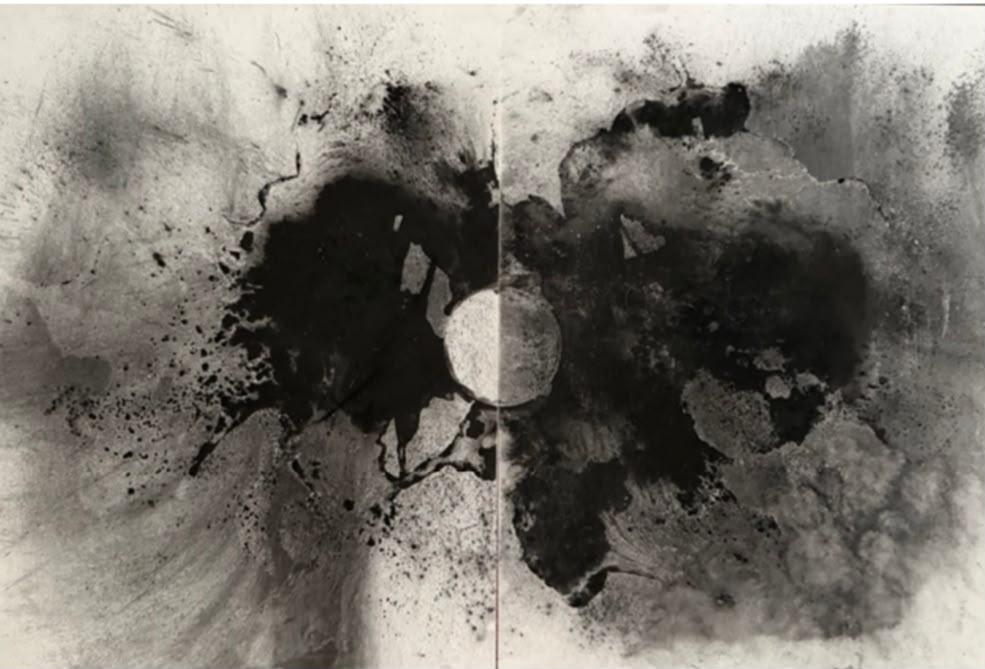
The same attention is directed outward in her subjects. Her charcoal Moonrise is a diptych because the moon, for her, is two things at once: looking at it is “a very lonely affair, “and yet it leaves her with “a sense of fullness.” This bilateralism exists in much of her approach; with one panel holding the moon alone in the night, shedding light, and the other holding the radiance “that fills the internal me, the inner me.” The split form carries what she calls “looking at and being looked at.” The more that Aditi explains the parameters of her own relationship to her work and her craft, the more that we can also see development of this ritualism in how an artist, such as Aditi, conceives the world around her. The practice of always looking again at the things that surround you, yet simultaneously also being perceived and, in some ways, changed by the very world that one confines to their imagination.
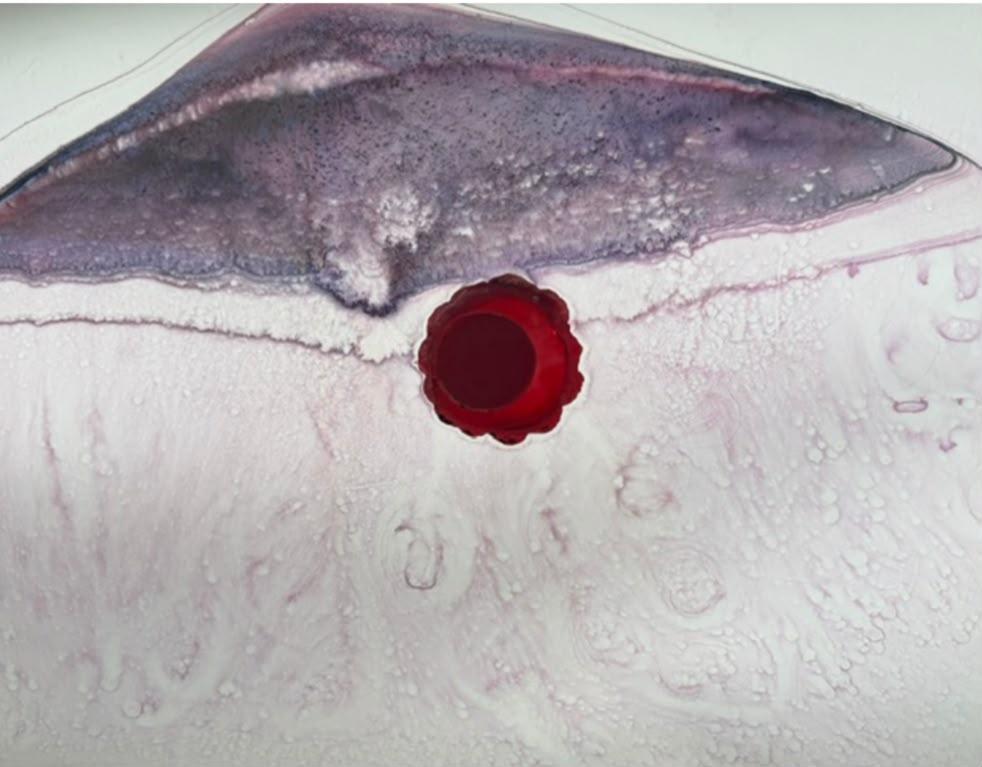
For example, The Red Mountain (Arunachala), which depicts Arunachala in the south of India, the mountain where the sage Ramana Maharshi meditated and opened his ashram, which Singh glosses as “a space of belonging.” In Hindu mythology, she says, the mountain is Shiva himself. Her devotion to it is strikingly simple; every year she goes and walks around it, explaining that “there’s no kind of ritual besides just walking around the mountain.” What she is reaching for is not a possession of the sacred but a place within it: “The sacred is not limited to a place. The sacred is within us.” Going to Arunachala is, for her, a way of remembering, “I’m so small in the universe, and the universe is so much larger than who I am.”
Surrender, in Singh’s work, is therefore quiet and daily, and, importantly, done through willingness and acceptance. A hand following a colour or a body circling a mountain, one is surrendering to something greater.
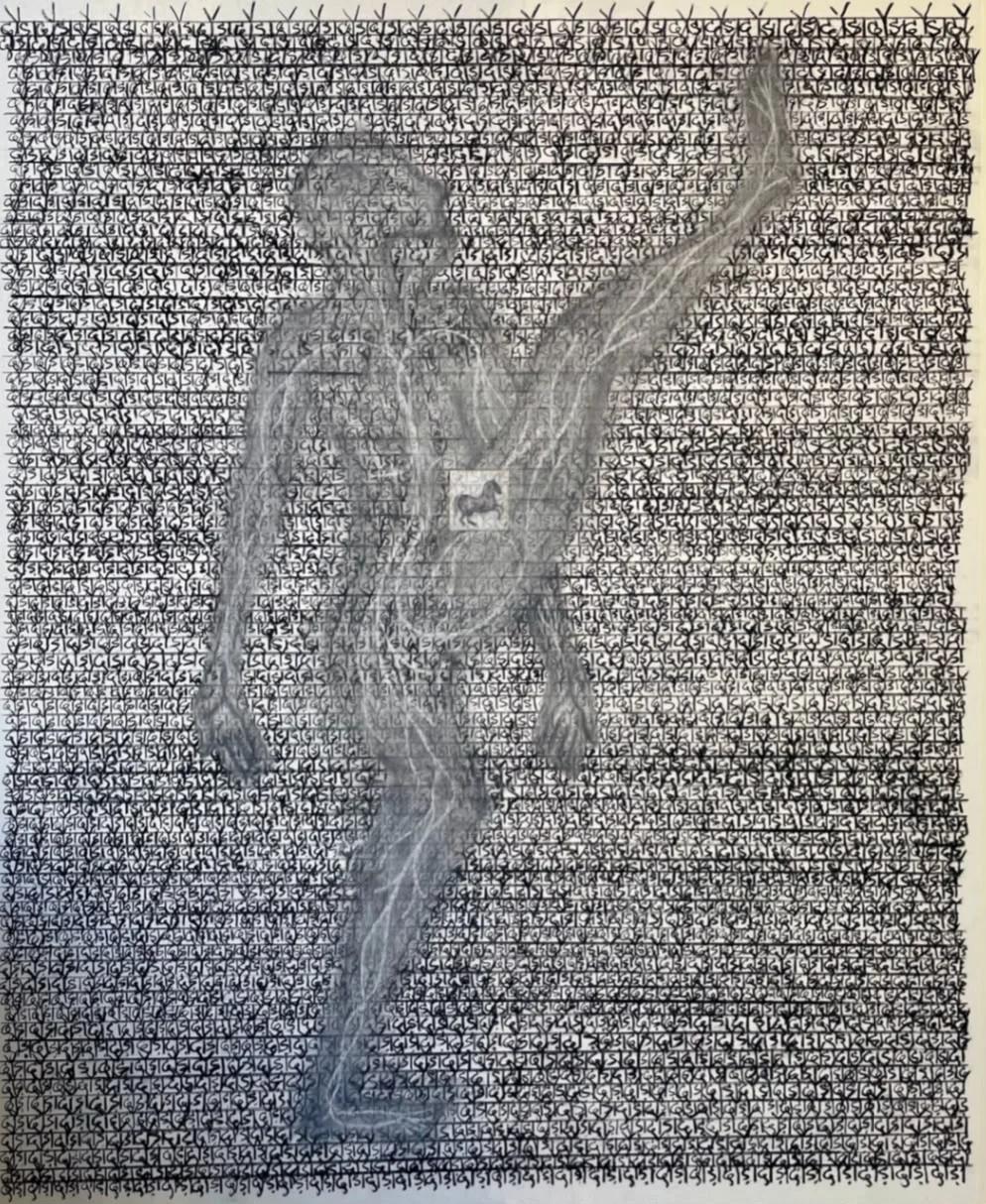
Vihaan Surya Singh arrives at surrender from the opposite direction. He lives and works between Jaipur and Amsterdam, is halfway through his undergraduate degree at the Rietveld Academie, and paints and photographs. His painting, Ashvamedha, takes on the Ashvamedha, a ritual in which an emperor lets a horse run free across his land and beyond for about a year. Whenever the horse strays into someone else’s territory, that ruler must either yield or fight. The ritual, Vihaan explains, is only attempted by someone “confident enough in their own power that they knew no one would challenge them.” What caught him was how much of what people tell each other is built on the same logic. “So many of our stories, as humans, are about conquering and possessing.” And yet, he says, being in love reverses it. “Suddenly what you want to do is not to conquer, not to possess, but to surrender. And that can be, in a way, equally brave and equally radical.” Turning the ritual inward and exploring it from within: “Can this be a more spiritual sort of horse running through your own being? And whatever the horse covers inside of you, is that something you can then give to someone instead?” This question begs the limits to which you are willing to surrender parts of yourself in love, in a way, a reminder of all the things that are waged against us in love.
Thus, the figure at the centre of the painting holds both ideas. The horse runs inside the body, with the veins as “the track that the horse is running on,” and the raised leg echoes Vamana, the dwarf of myth who crosses “earth, hell and heaven” in three steps. It is a story of encompassing and possessing, and Vihaan’s question about it is a gentle one: how can these stories be turned inward, “giving instead of taking”? Here Vihaan adopts a similar methodology to Aditi and locates his work inside the human body.
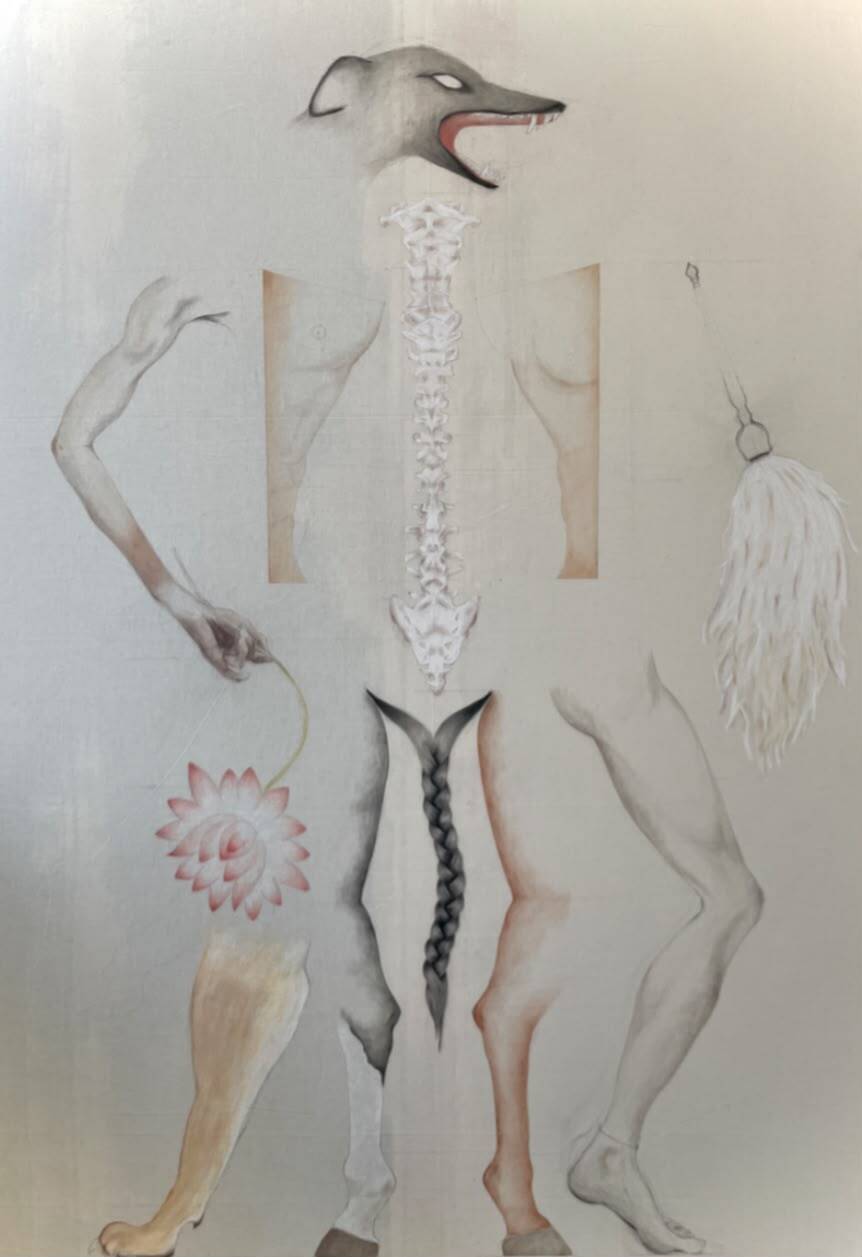
His painting, The anatomy of a desire I don’t understand, positions the various twinges of love and surrender within the human body by completely restructuring its different components. A poised arm for pride, an animal head for ugliness and, at times, despair. Our very experience of the ways love can boost us but can also devour and demolish us is explored through a fictitious restructuring of the human body.
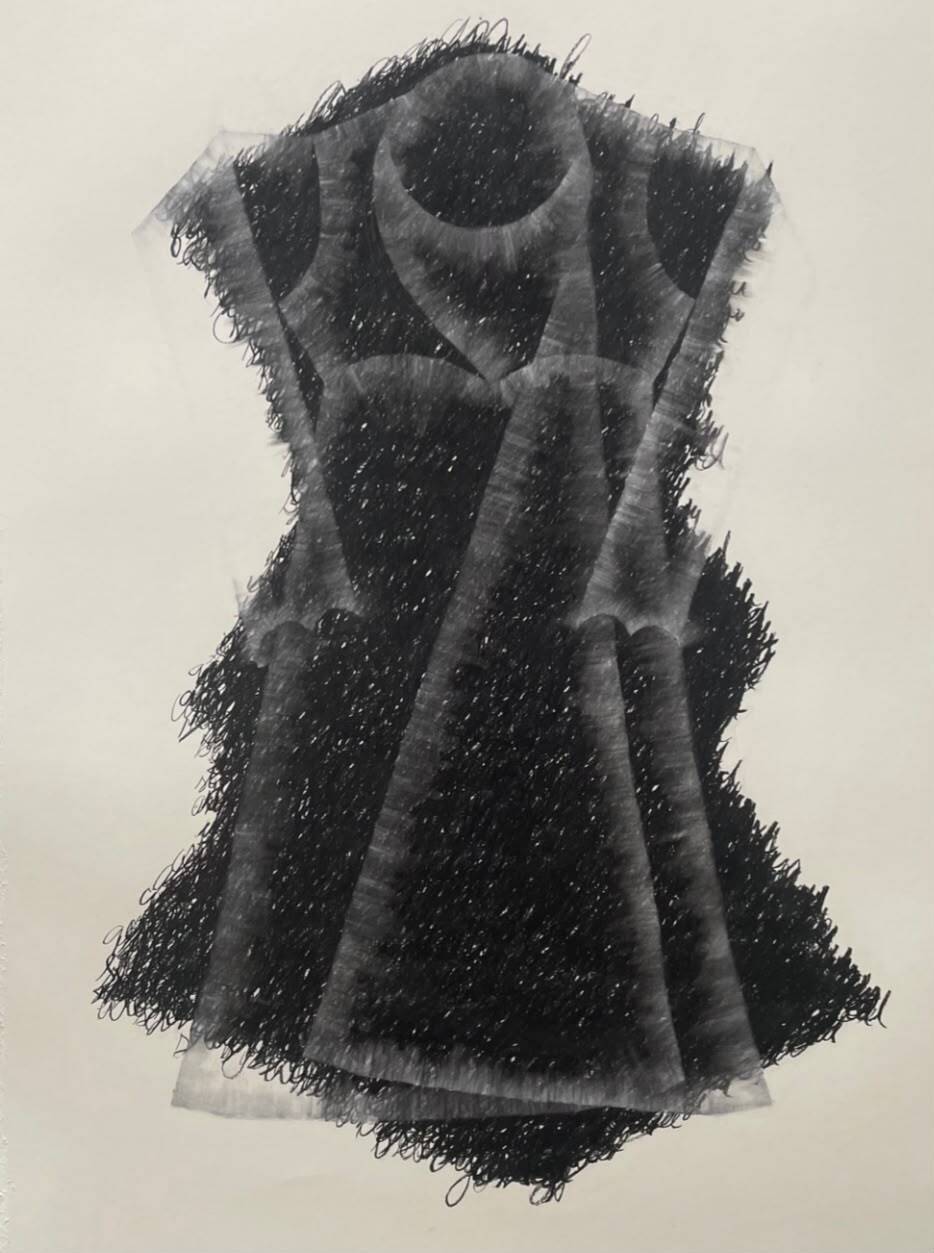
His other work, If you say I will stay, holds opposites in a different way. A dress sits above a mass of writing. The garment is an angarkha, an old Indian court garment he associates with people of refined taste, and it was made of fabric so delicate it “would tear quite easily,” so that the wearer “had to be very mindful when moving in it.” He set that over a shape that is “very jagged,” even violent in places. “I really wanted an image in which I could hold those two together.” Beneath the dress, he writes the same words over and over in charcoal: “I will come, I will stay.” Again and again until the text is a black mass, and here, his practice meets Singh’s. He is drawn to “this sort of tipping point where text stops becoming text, and it just becomes shape and form.” Near the end, “you don’t really even know what you’re writing anymore, but your text is just being absorbed into this form.” It is the moment when the maker’s control gives out, and the material carries on. The words themselves are the surrender. “The most that you can give someone is not to say that ‘I will do this for you, I will get that for you,’ but just that ‘I will stay.’” This, for him, is “the most beautiful and powerful thing you could give a person.”
Lastly, our final artist’s journey begins in a quaint family home in Panipat, India, where Samanta Batra Mehta found a love for gardens long before a paintbrush ever entered the picture. “My engagement with gardens and botanical forms predates art,” Samanta explains, tracing the feeling back to her grandfather, a botanist who taught the subject and planted agricultural land. An ornamental garden grew at the front of the house and a kitchen garden at the back, and the children were let loose among both. Landscape was never just an idea but a place to linger, and Samanta has carried that in her art ever since.
Born in Mumbai in 1975, she has lived in New York for more than two decades, and her work draws on that long-distance relationship: from the subcontinent, from the places her family once planted, and from the question of where a person finally lands. Her new body of work for NAP+, The Sacred Garden, gathers that question into a single form as it unfolds in three movements.
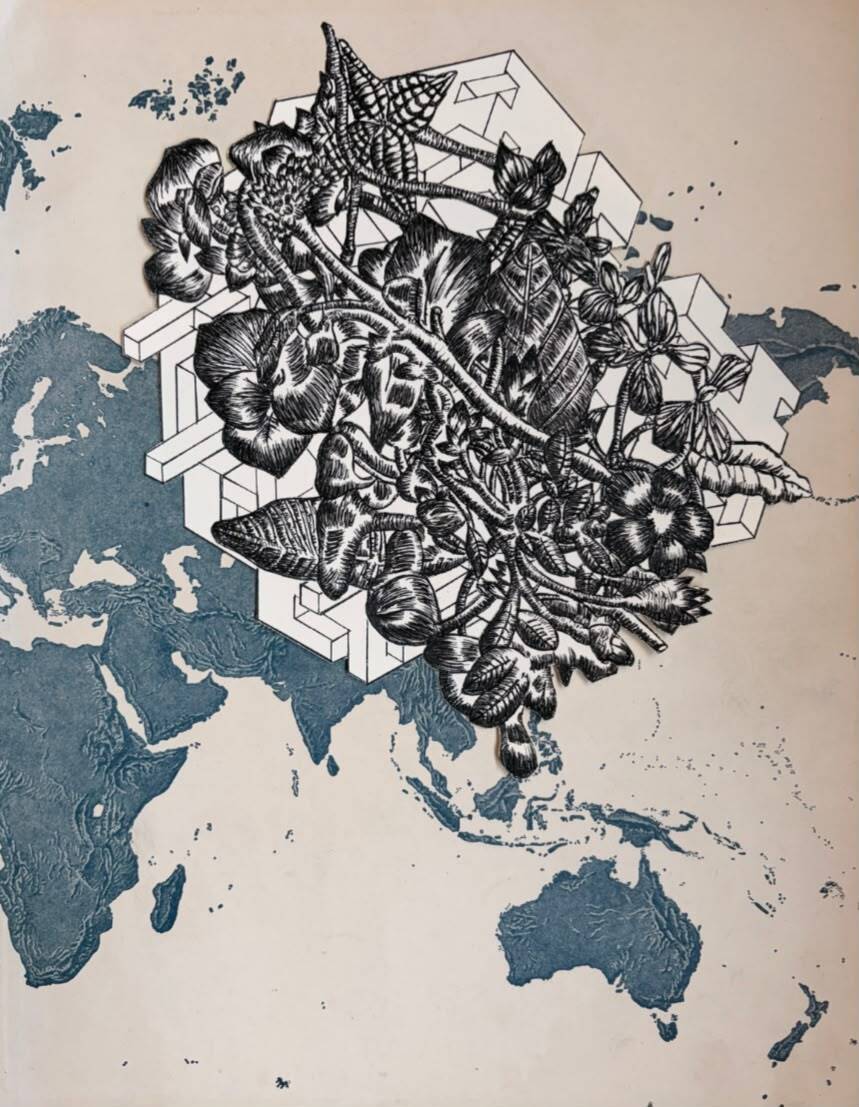
The journey begins in the Persian and Mughal charbagh, the quadrilateral garden. In the Shade of a Distant Tree, four parts stand for the land itself, and a fifth acts as the connector that holds them together. Across antique maps, Samanta draws botanical forms, so that the careful borders of cartography become soil for something that grows. The garden is laid over the world as it was measured, and quietly overtakes it, nothing here is fixed. “There is always a temptation to tinker,” she says. “I don’t think the work is ever done.” The charbagh gives the work its order, and the tinkering keeps that order from ever hardening.
She surrenders the idea of fully completing an artwork, and the belief that a thing must stay as it was made. She gives herself over to the pull of objects other people let go of, and to the slow rewriting of one image by another. Even the garden, so often a plot of land with a boundary, becomes in her hands something tended and then released.
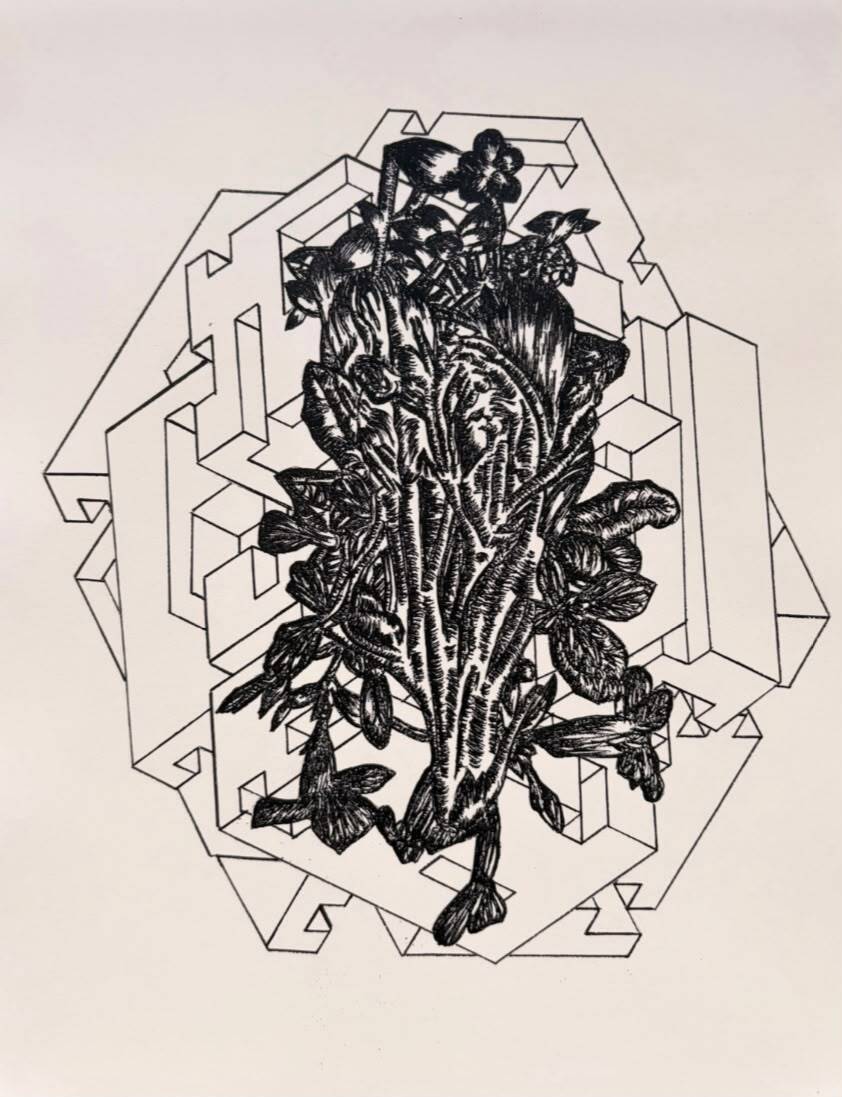
From the courtyards of the Mughals, the work crosses into the walled gardens of medieval Europe. The Hortus Conclusus was built for contemplation, a small paradise enclosed against a restless world. Two traditions that don’t quite share a geography arrive at the same longing, to hold the sacred within walls. Here the garden turns inward, and the landscape becomes a state of mind. Samanta describes the work as a mooring, a wandering through “the garden of my soul.” It is a vessel caught between drifting and anchoring, and it echoes what she names as a very human need: “We, as a people, are always looking for a place to land, a place for solitude, somewhere to feel at home.”
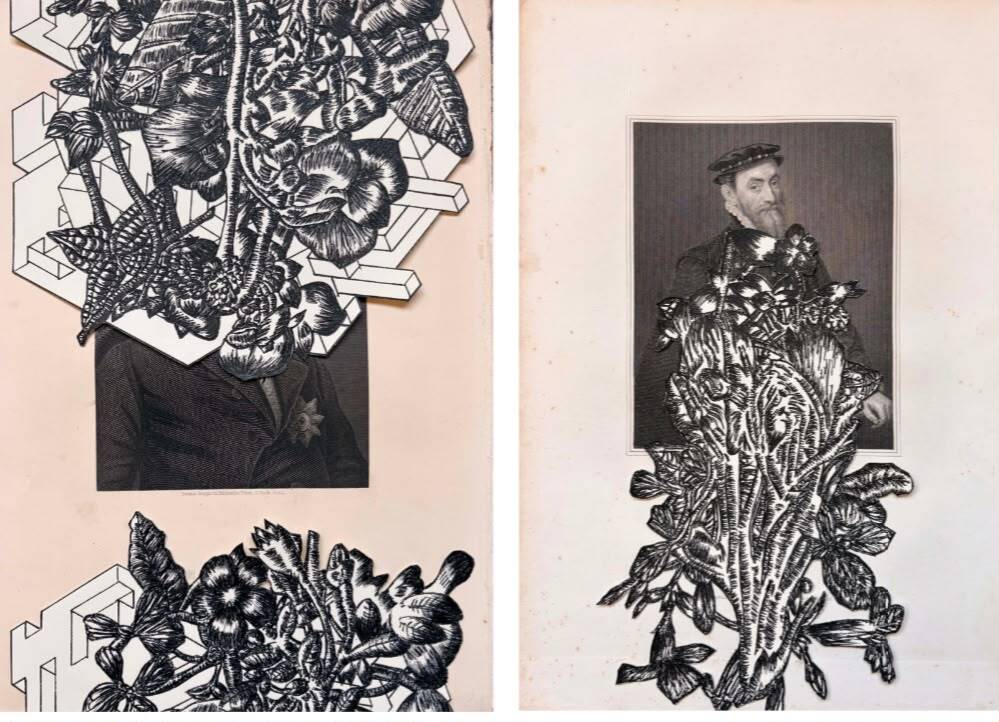
The final movement turns toward a broken form of nostalgia and becomes an elegy for the Partition of 1947, when the subcontinent was divided into India and Pakistan, and millions were uprooted from the places they called home. In What the Land Remembers, Samanta places vintage portraits of noblemen, found in flea markets and antique shops, into her landscapes. These are objects no one wants or owns, handled with reverence and a care to represent them kindly. Partition arrives in this work not as history witnessed but as history inherited, felt through a transgenerational empathy, a vicarious grief passed down and still unresolved. Memory here, for Samanta, is not neutral. “We remember what we want to remember,” she points out. “We end up having a unique relationship with the memory.” Standing at a midpoint, neither inside the past nor outside it, she surrenders to that in-between. The remnants are still there, as in the work itself, where the original is altered but never erased, and a trace always remains.
“I am drawn to them precisely because they are forgotten objects,” she says, and in her hands the forgotten are given somewhere to rest.
All in all, the artists from SAC Art represent, within their work and within themselves, a cyclical habit of both surrendering to their work and having the work surrender to them. Aditi Singh discusses the importance of surrendering the body, willingly, to the space and time it is suspended in. Finding a balance in how control moves and shapes the work she makes, whilst also retaining a centre and a base, somewhere, within the body itself. For Aditi, art becomes an expression of the inner rituals and beliefs we hold with the world around us. Vihaan represents a more symbolic surrender, one that is not necessarily intentional or willing, yet remains all-encompassing. Vihaan focuses on love and all the despair that comes with it. Here, loss of control is not part of a process of “becoming” but rather a part of falling even deeper. For him, desire runs through us, like a horse, with its monotheistic repetition of dauda, dauda, dauda. He turns rituals such as the Ashvamedha on their head, and creates a new lens, a new pair of eyes for us to gawk at the inner workings of love through. Samanta Batra Mehta showcases a surrender to memory. Her work is historical and archival in nature, she traces a similar relationship to the land as Aditi, in which she searches for an active answer, piecing together remnants of archival images and botanical illustrations in order to puzzle out what something, such as the 1947 Partition, meant to the memory of the land itself.


Comments
No comments yet.
Log in to join the conversation.